After bidding farewell to Melbourne, we resumed our journey across this fantastic continent by car.
The Great Ocean Road is Australia’s third-most-visited tourist attraction.
(We have already visited the first one, the Great Barrier Reef and the second one is planned for our next visit, Uluru National Park.)
The Great Ocean Road is recognised as one of the most beautiful roads in the world. Along with the Great Barrier Reef and Uluru-Kata Tjuta National Park, it is included in the List of Australian Natural Heritage Sites.
The first thing that awaited us on the route was a waterfall. There are a million of them in Australia, but we have never been able to see an ordinary waterfall before. Either they were all funny (read “small streams”), or we were too lazy, at the wrong time, or twice to go to them.
Unsettling signage akin to the alert, “Australia is home to the most dangerous animals on the planet,” could be seen all along the route!
It is prevalent and convenient to rent campervans in this country. They are as popular as the campsites for them! Many of the motorhomes have four-wheel drive!
Erskine Falls, near Lorne. It is gorgeous and easily accessible by car. Camping tourists use it as a powerful shower. The path from the parking lot is no more than a hundred metres. To reach Erskine, you must ascend a short flight of stairs.
You can even swim up to the waterfall, but as you do, the tourists taking pictures from the observation deck will quake, fearing that you will ruin their shot! Among the local attractions, huge boulders stand out, with which every second tourist wants to take a photo. The air near the waterfall is clean and humid and smells of vegetation.
The waterfall is small but extremely picturesque. It is 30 metres high and surrounded by numerous ferns and eucalyptus trees.
Having rested in this fresh and cosy place, we drove further along the Great Ocean Road! Ahead are 200 km of serpentines and five dozen observation platforms (observation platforms).
On the way back to Lorna, we noticed people standing on the side of the road taking pictures of something above. We realised quickly that there were koalas! They also stopped and began filming. Other passing tourists saw this and also slowed down. So we passed the baton!
Here, we saw wild koalas for the first time! More precisely, a koala’s butt. The bear was sleeping.
We also saw the butts of horses. Sometimes, the Great Ocean Road does not run straight along the ocean but goes deep into the mainland.
Construction of the Great Ocean Road began in 1919. The worker-soldiers who built the road were “rewarded” in an unusual way for their challenging work. In 1924, the steamship Casino, carrying 500 barrels of beer and 120 alcoholic beverages, landed on reefs near the road under construction. The worker-soldiers “saved” the cargo, causing construction to stop unplanned for two weeks.
A beautiful estuary and the Shipwreck Coast.
This 130-kilometre coastline, stretching from Cape Otway to Port Fairy, is associated with a tragic period in Australian history.
Explorer Matthew Flinders said of the site: “I have rarely seen a more terrifying stretch of coastline.”
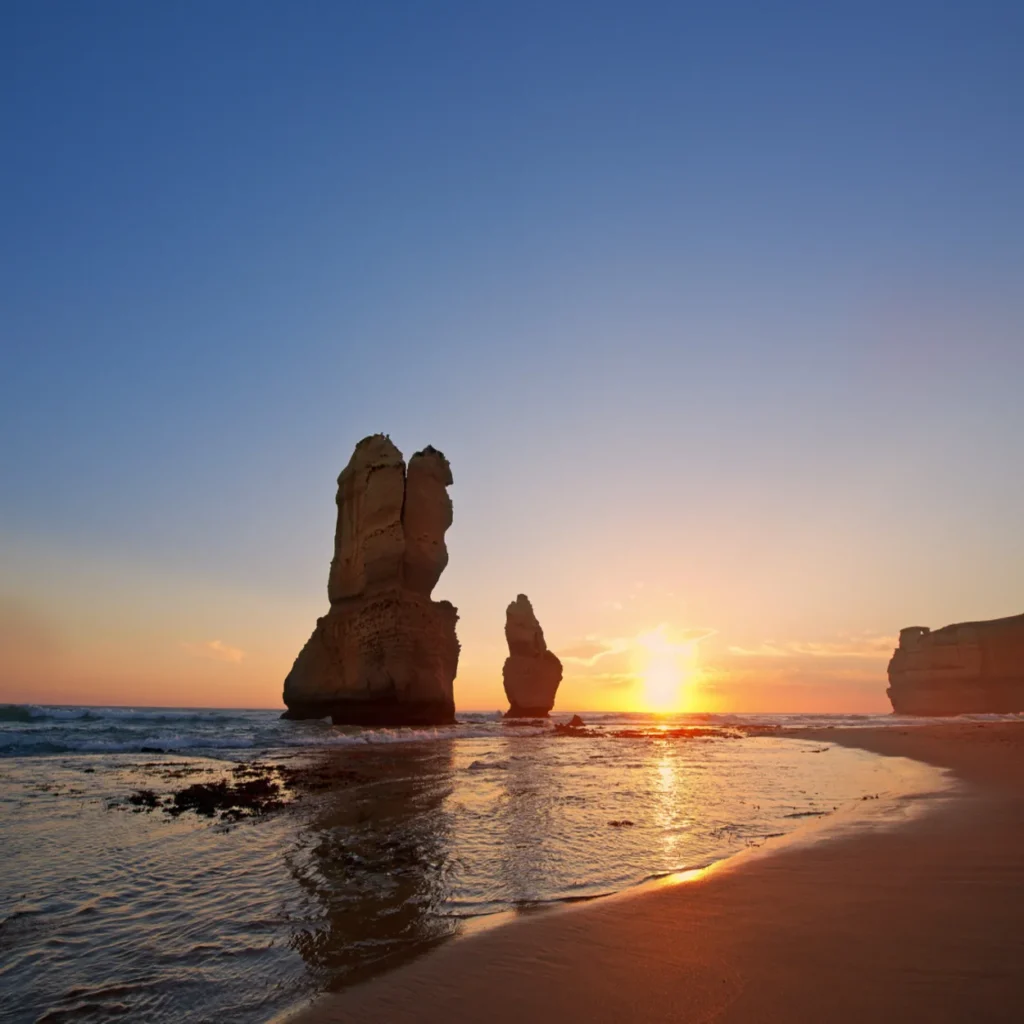
There were approximately 638 shipwrecks along the Victorian coast between 1836 and 1940, but only about 240 were recovered. A storm that forced ships into submerged limestone formations was the primary cause. Tourists are now actively taking pictures of these limestone rocks, which are their “relatives” and have not yet collapsed.
Explore the famous guided Great Ocean Road tour from Melbourne. Witness the Twelve Apostles and other natural wonders on this unforgettable journey. Book now!